

Clearing the Air, Literally
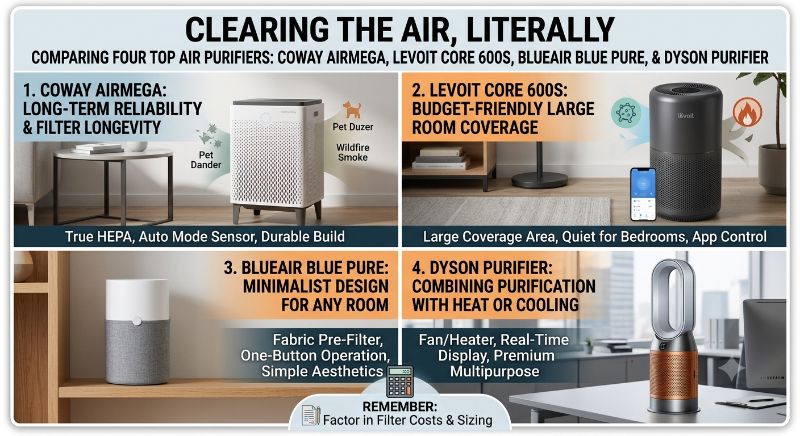
Air purifiers used to be a niche allergy-sufferer purchase. Now, between wildfire smoke seasons, pet dander, and general indoor air quality awareness, they’ve become a mainstream household item — which means the market is full of options with wildly different price tags and genuinely different strengths. We compared four of the most recommended purifiers in 2026: Coway Airmega, Levoit Core 600S, Blueair Blue Pure, and Dyson Purifier.
Coway Airmega
Best for: Long-term reliability and filter longevity
- True HEPA filtration with a strong reputation for consistent performance
- Filters typically last longer between replacements than budget competitors
- Auto mode adjusts fan speed based on a built-in air quality sensor
Coway has built a loyal following largely through word of mouth, and it holds up under scrutiny — the auto mode genuinely responds to real air quality changes rather than running at a fixed speed regardless of conditions, and the filters last long enough that replacement costs don’t sneak up on you every few months.
Levoit Core 600S
Best for: Budget-friendly coverage for larger rooms
- Strong coverage area relative to its price point
- Quiet operation on lower fan speeds, good for bedrooms
- App control and scheduling included without a premium upcharge
Levoit consistently undercuts the competition on price without cutting corners on the specs that actually matter — coverage area and noise level. For anyone purifying a bedroom or living room without wanting to spend flagship money, it’s usually the first recommendation worth considering.
Blueair Blue Pure
Best for: Minimalist design that fits into any room
- Simple, fabric-wrapped design that looks less like an appliance
- Washable pre-filter reduces ongoing maintenance costs
- Straightforward one-button operation, no complicated settings
Blueair’s appeal is as much aesthetic as functional. The fabric pre-filter design means it doesn’t look out of place in a living room the way a lot of purifiers do, and the washable component cuts down on how often you’re buying replacement filters throughout the year.
Dyson Purifier
Best for: Combining purification with heating or cooling
- Several models double as a fan or heater, saving counter space
- Real-time air quality readout displayed directly on the device
- Premium price reflects Dyson’s broader multi-function design
Dyson’s purifiers justify their higher price by doing double duty — several models also function as a fan or heater, which can genuinely replace a separate appliance rather than just adding another box cluttering your room. The real-time display is also more detailed than most competitors bother to offer.
Sizing your purifier correctly
The single most common mistake buyers make isn’t picking the wrong brand — it’s buying a purifier rated for a smaller room than they actually have. A purifier rated for a 200-square-foot bedroom will struggle in a 400-square-foot open living space, running constantly at max speed and still underperforming the whole time. Check the manufacturer’s room-size rating against your actual square footage using a free Unit Converter before comparing features, especially if a listing uses square meters instead of square feet.
Ongoing costs to factor in
The purchase price is only part of the real cost. Filter replacement frequency and price vary significantly between these four, and a cheaper purifier with expensive, frequently-replaced filters can end up costing more over two years than a pricier unit with long-lasting filters. Factor a rough estimate of annual filter cost into your comparison, and use a free Discount Calculator when filter multi-packs go on sale to figure out whether stocking up now actually saves money versus buying one at a time.
Final Recommendation
Want proven long-term reliability? Coway Airmega. Need budget-friendly coverage for a larger room? Levoit Core 600S. Care about how it looks in your space? Blueair Blue Pure. Want purification bundled with heating or cooling? Dyson Purifier.
Leave a Reply